


-1761147112036.png)


the INPS numbers
The double burden of being a woman in Sicily: fewer than 4 out of 10 have a job and permanent contracts go to men.
The data, as well as the stories of those who could tell this difference starting from their own daily lives, say so. The Inps captures an emergency situation.


Being a woman and living in Sicily is hard, much harder than for those living in other Italian regions. At work and at home. This is evidenced by the numbers, as well as the stories of those who could recount this difference starting from their daily lives. The Inps, in its report Gender Report 2025, depicts an emergency situation. On the island, just over three out of ten women work, six out of ten are inactive, and the vast majority of these do not seek employment. This phenomenon also affects younger women.
“From the Focus on Sicilian data - explains the president of the regional Inps committee in Sicily, Valeria Tranchina - we find that the female disadvantage is the result of structural problems that are even worse compared to national averages.”
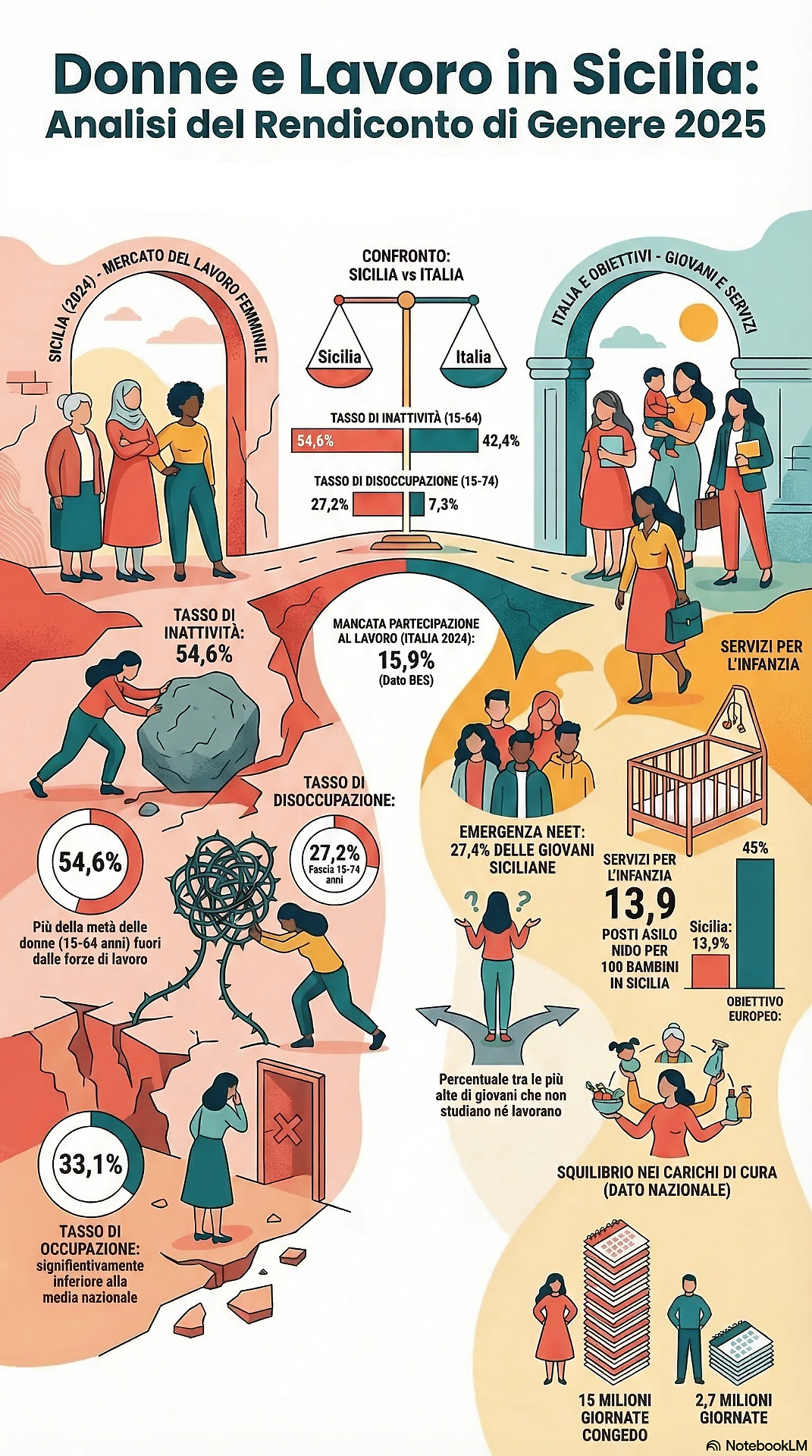
The numbers: the female unemployment rate is 15% compared to the 11.8% male rate; the inactivity rate among women is 58.8% compared to 33% for men. Even among Neet - young people aged 15 to 29 who are not studying, working, or following a training path - the female gender in Sicily shows the second worst national percentage at 27.4%.
If we look at the overall employment rate, the female gender in Sicily stands at 37.5% (only 535,000 women out of 1.4 million over 15 are employed), while the male rate is at 62.5% (892,000) with a gap of 25%, a value higher than the national figure of 17.8%.
Looking at the new hires for 2024, female hires represent 36.3% of the total. Considering the type of contract, “among those permanent - specifies the president of Inps Sicily - only 31.4% are women compared to 68.6% men. And, furthermore - she adds - in the total number of part-time hires, women account for 53.4% compared to 46.6% of men, confirming that women are more often employed in discontinuous, precarious, voluntary and involuntary part-time jobs, low-wage work, and confined to sectors with low added value.”
It is evident that the working condition deals with educational services for early childhood that are largely insufficient. Sicily offers only 13.9 places in nurseries for every 100 children (0-2 years), ranking last in Italy along with Campania (13.2). The minimum target set by the European Union of 33 places for every 100 children is very far away.
«The report highlights how working women are penalized in the labor market, especially during the maternity phase - emphasizes President Tranchina - with a peak of difficulties during pregnancy that persists into the various age groups of children. The lack of a network of nearby social infrastructure is reflected in salary penalties and career progression due to the general caregiving of family members (children, the elderly, and the vulnerable) - not only nurseries, but also full-time schools, residences for the elderly and non-self-sufficient, and social services for disabilities. Women continue to be the social buffer of the Sicilian community.
The latest data confirming the disparity between Sicily and the rest of Italy is that regarding life expectancy. For Sicilian women, it is about 83.7 years, two years less than the national female average of 85.6 years.