


-1761147112036.png)


The intervention
Catania, proposals for a "Resilient Waterfront"
Carmelo Ignaccolo, professor of Urban Design, Technology & Climate at Rutgers University in the United States, shows the solutions adopted worldwide to protect coastlines


About a year ago, on January 19, 2025, nature sent a warning along the waterfront of Catania. The concrete slab of Piazza Tricolore, long closed and fenced off, gave way under a storm surge, revealing the buried sea, the coves with volcanic sands, and the black pebbles hidden beneath the concrete cap. Mayor Trantino was clear: "Nature has reclaimed its space." Twelve months later, nature is knocking again (or rather, overwhelming) the waterfront of Catania and, with it, all of Eastern Sicily. Sections of the Catania waterfront have collapsed, roads are closed, a city is assessing the damage after an emergency managed masterfully, without casualties, and is now questioning the already contracted works for the new pedestrianized waterfront in light of what has happened.
The question seems to be not only how to repair, but rather whether it is still worth doing it the same way.
From this side of the Atlantic, I observe the crisis in Catania with the clarity that distance provides and with the pain of someone who knows that lava coast meter by meter. Here, in the metropolitan area of New York, I teach urban planning and climate resilience at Rutgers University and, about eight years ago, I worked with the urban design firm AECOM on waterfront redesign strategies along the Hudson River, following the devastating Hurricane Sandy. Sandy, in 2012, was for New York what I hope Harry will become for Catania: a breaking point that forced the city to choose between repairing and rethinking. The city administration under Mayor Bloomberg, guided by the Obama administration, responded with the federal initiative "Rebuild by Design": not to rebuild as before, but to design differently. The paradigm shift was radical: to stop engineering coastlines as if they were enemies to be contained and start designing them as living ecosystems for climate resilience and community well-being. Manhattan has recently inaugurated the first parks of the “Big U” on the eastern waterfront: a continuous system of urban parks (“parkipelago”), designed by the leading urban design firms (including the master plan by Danish Bjarke Ingels Group) and landscape architects, following the U-shape of the island. On calm days, the “Big U” is a park; on the day the storm arrives, it is a barrier that absorbs and protects. Off the coast of Manhattan, to slow down wave action, the landscape architecture firm SCAPE led by Kate Orff — with whom I trained in New York — designed the "living breakwaters" off the neighborhoods of Queens and Staten Island: breakwaters designed as underwater habitats made up of oysters that, at the same time, purify the waters of the harbor. Infrastructure and ecology, in the same gesture.
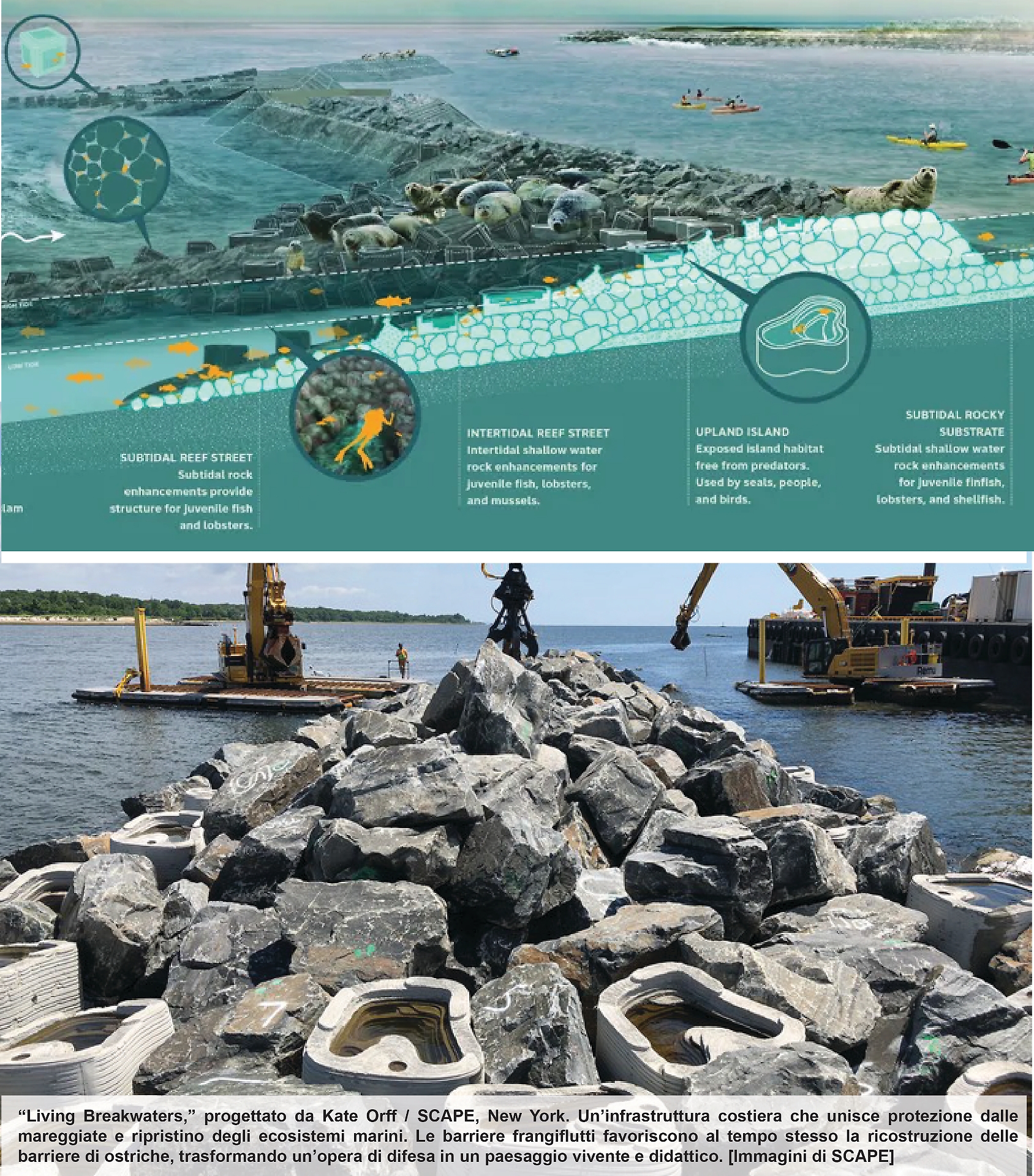
What lessons can Catania draw from all this? It would be naive to think that the resources and the modus operandi of New York are transferable tout court to the slopes of Etna. But the approach of “Rebuild by Design” — funding not the repair of damages, but a deep rethinking of the relationship with the coast — is exactly the reasoning I hope there will be the courage to initiate for the entire eastern coast. Catania, however, has a significant advantage over New York: its lava topography, in the most urbanized part, naturally elevates and protects it from the sea, while not making it immune to erosion.
The principle adopted in many rocky shorelines subject to erosion in urbanized areas is what we call in the United States "managed retreat", that is, managed retreat. It is not a surrender of man; it is a strategy of adaptation and, at the same time, of repair. It means recognizing that some coastal structures are unsustainable in the long term and that retreating with intelligent design can give the city back more than it has to lose. The waterfront of Santa Cruz in California and that of Carlsbad, thirty kilometers north of San Diego, show what managed retreat means in practice: entire traffic lanes have been de-paved and returned to the natural rocks that were once submerged by asphalt. In Carlsbad, in some sections, the road has been completely removed to make way for new descents to the sea and urban beaches, with a view to returning to nature and the community.
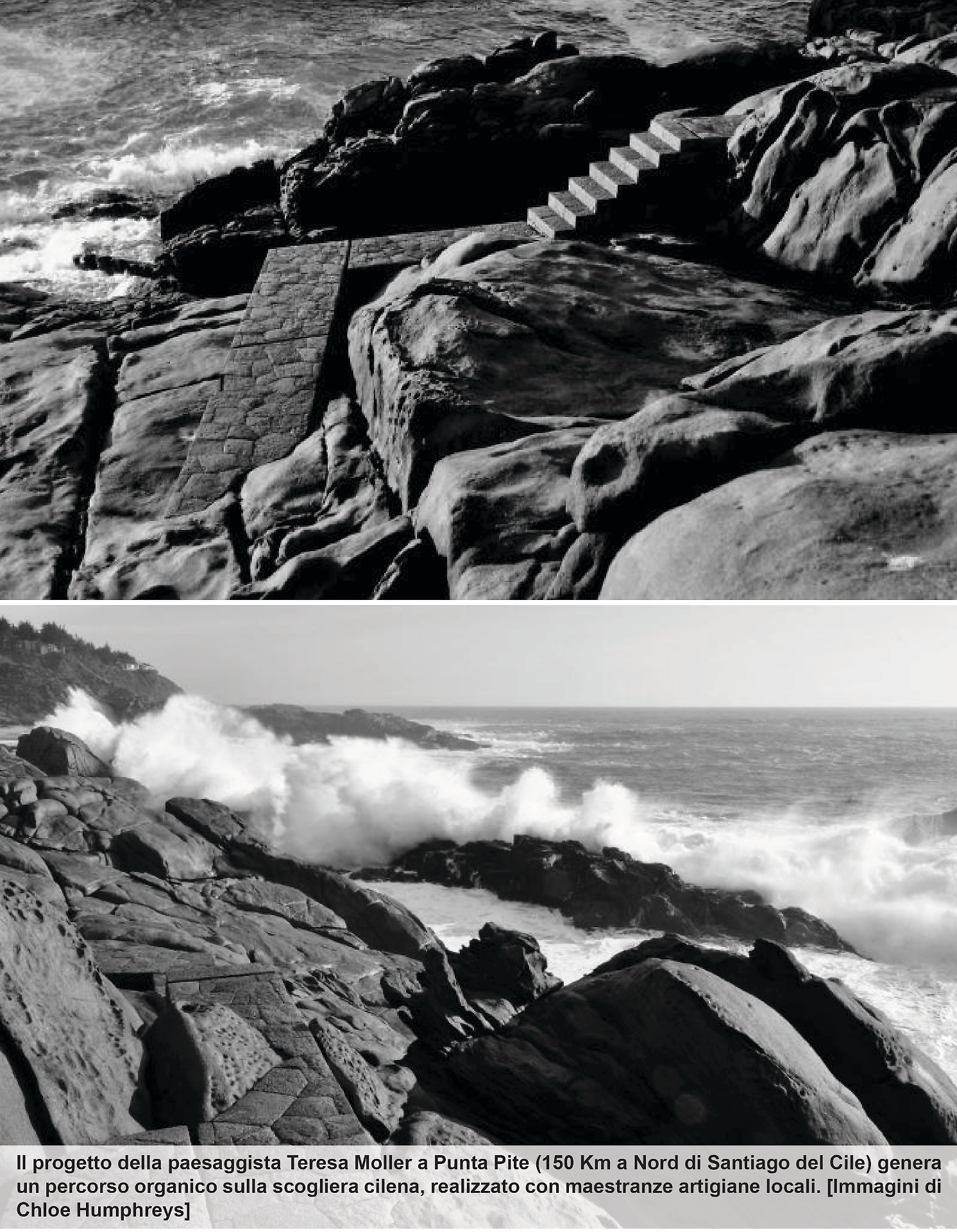
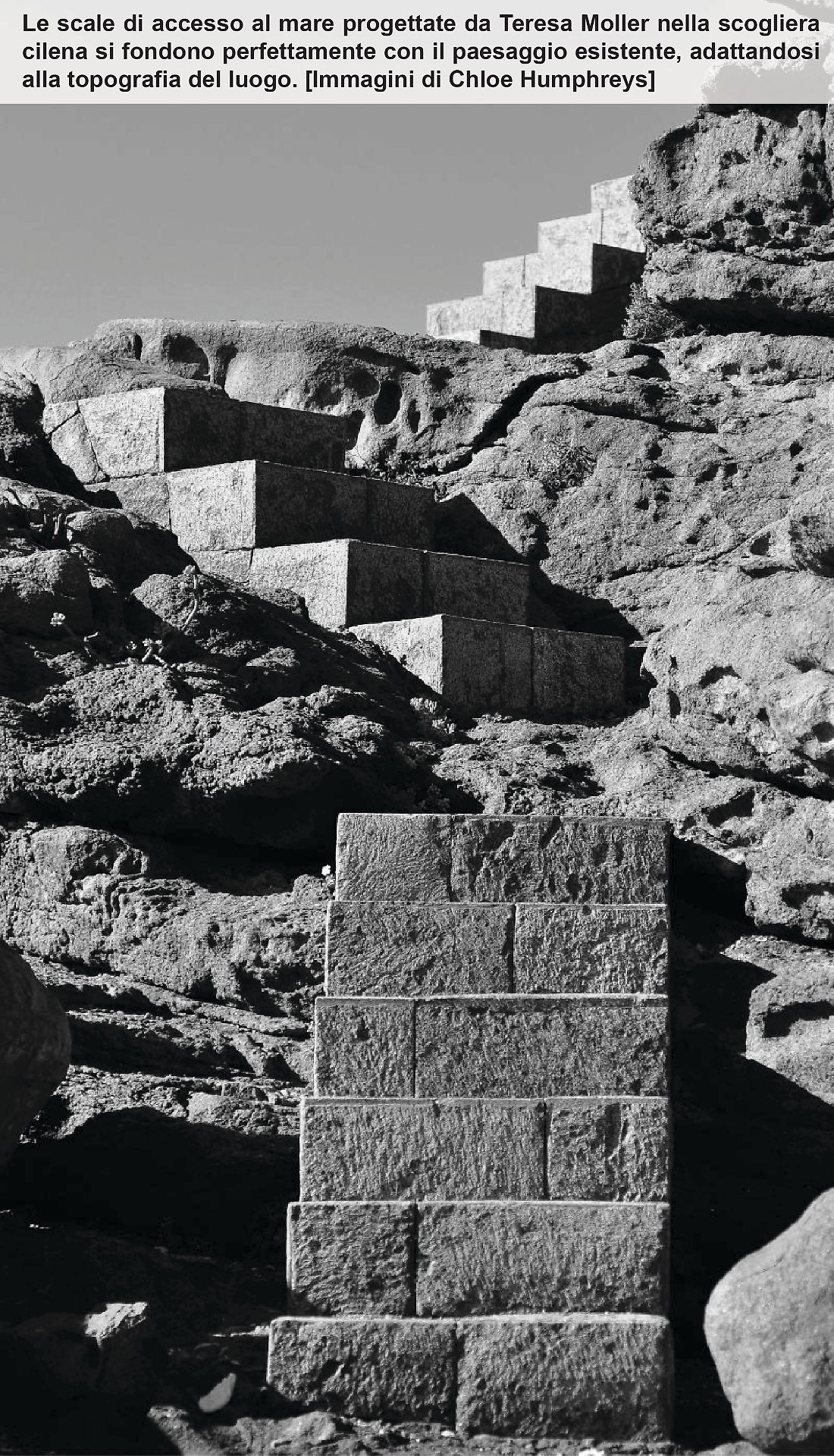
Once the principle is understood, the question becomes how to design this retreat well on a rocky coast that is very steep in places, like that of Catania. Concrete examples exist, and they speak a design language that Catania can recognize. The project by landscape architect Teresa Moller on the rocky coast north of Santiago de Chile surrenders to the topography instead of fighting it: the same local stone, worked by artisans with techniques not far from those of Catanese basalt, creates paths that embrace the cliff and open access to the sea without violating it.
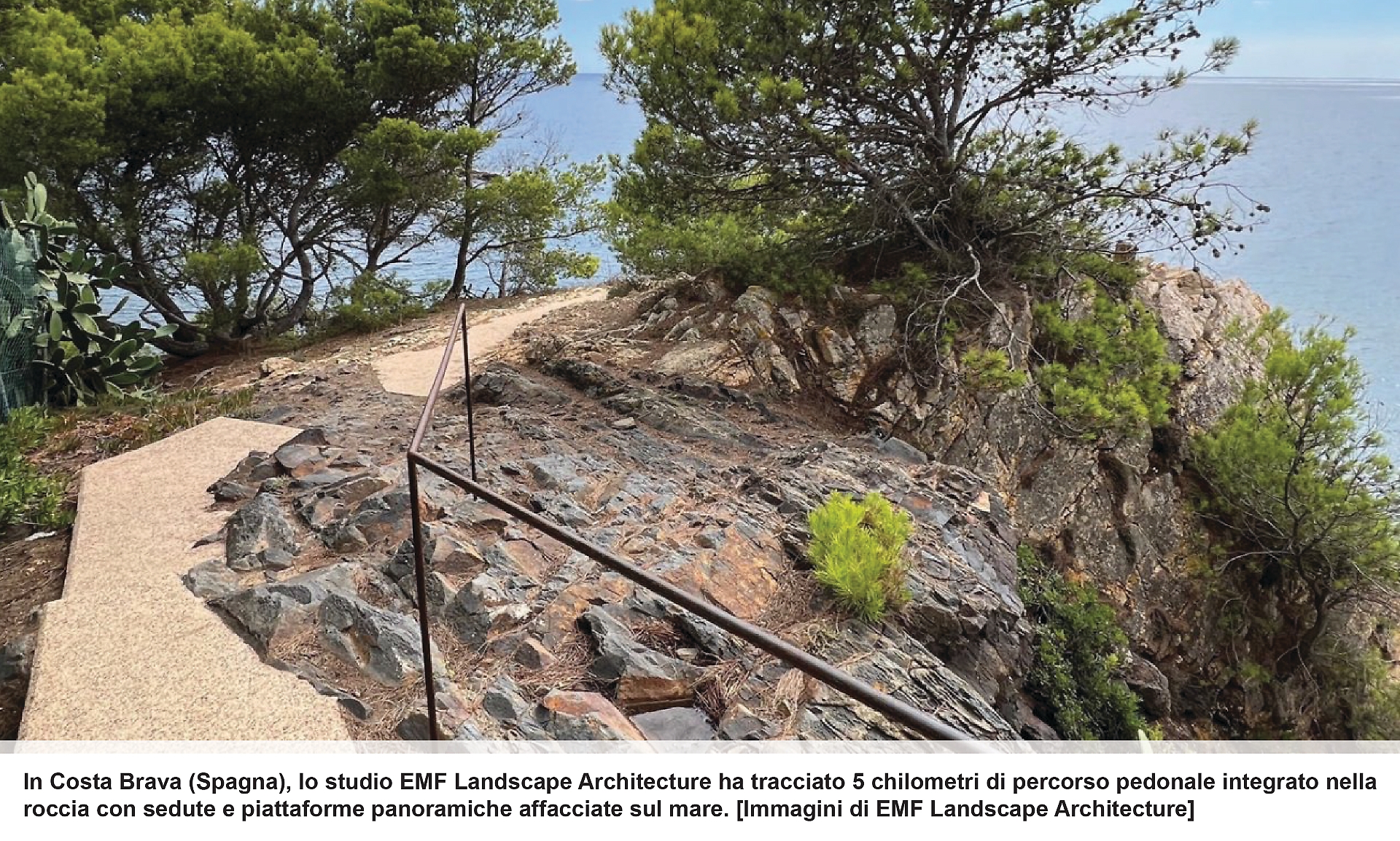
On the Costa Brava in Spain, the firm EMF Landscape Architecture has traced 5 kilometers of pedestrian path integrated into the rock — seating areas, platforms overlooking the sea, minimal interventions with great effect.
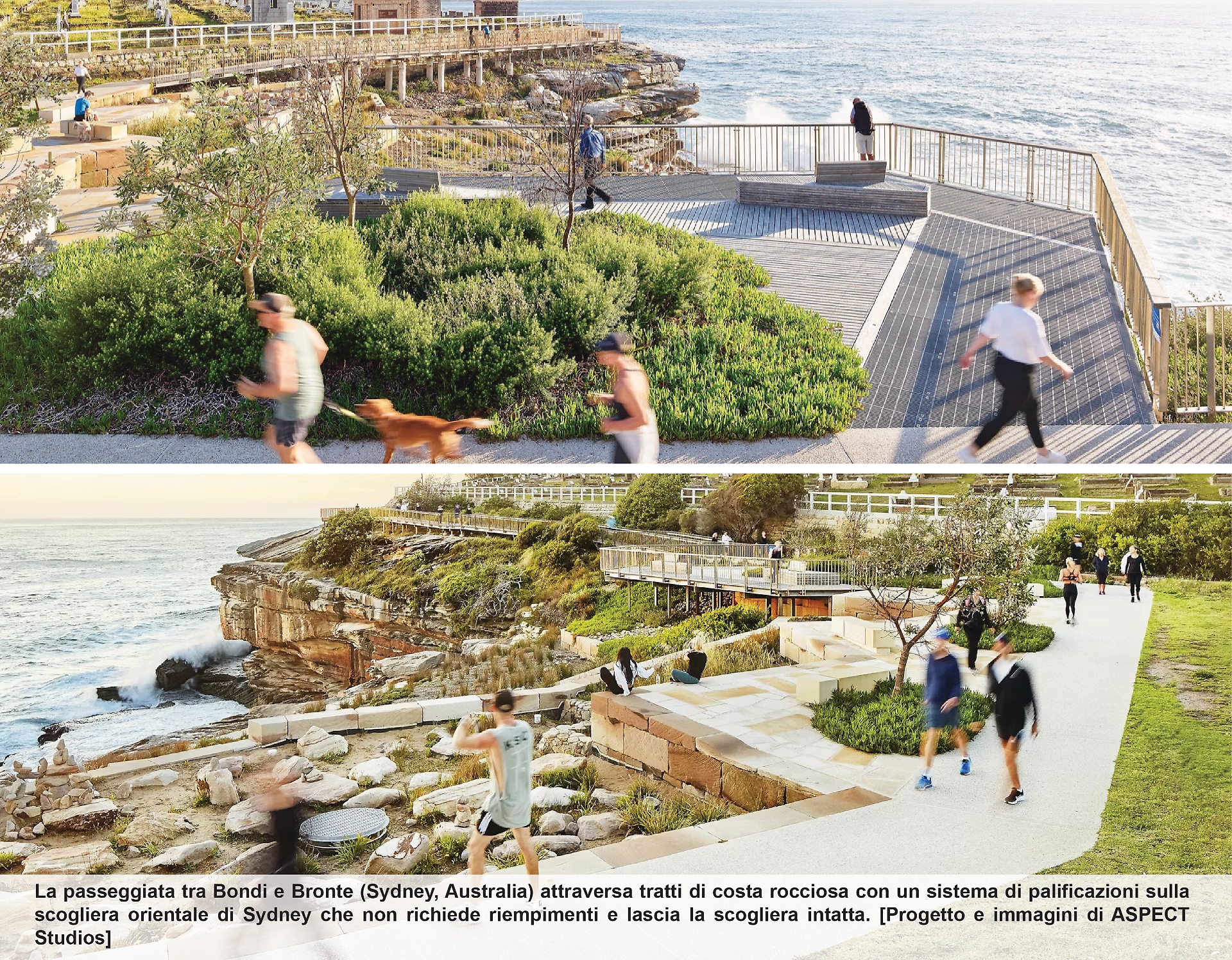
In Sydney, the walk between Bondi and Bronte crosses kilometers of rocky coast with a system of pilings that does not require fill and leaves the cliff intact. None of these projects have built walls. All have left space for nature and designed with it, giving communities more accessible waterfronts and a more enjoyable seafront.
Catania has a historic opportunity that few coastal cities have had: the sinkhole in Piazza Tricolore, the damage from Harry on the sidewalks and in the lanes adjacent to the sea, including the access road to Porto Rossi, has already begun the work. Where the concrete floors and fill with debris materials (some of which are said to date back to the rubble from the demolition of Corso dei Martiri in 1957) give way under the force of the sea, lava inlets with black sands and pebbles that no one remembered appear. Images of emerged beaches under Piazza Tricolore and near Porto Rossi are circulating on social media, leaving the community in disbelief: beautiful and unknown places to most, hidden for decades under concrete or debris. It is the waterfront that returns what was taken from it. The question is whether the city has the courage to collect what the sea is offering.
Yet the main problem of Catania's waterfront has never been the devastation of storms: it is that the sea is visible but not reachable. A waterfront reduced, fundamentally, to a road with a view. The project currently being implemented between Piazza Nettuno and Piazza Mancini Battaglia takes a step forward by eliminating vehicular traffic, but suffers from a limitation likely intrinsic to the tender: it does not address the issue of access to the cliff and the sea. As a result, it reproduces the linearity of the waterfront imposed by the urban highway of the 1950s. The principle of managed retreat could be integrated into the project and used to overcome that artificial linearity, restoring the jagged coastline through a series of widespread interventions, including descents to the sea carved from the natural shape of the rocks, removal of fill that has already proven fragile, and reconfiguration of the squares as systems of terraces sloping down to the water. Places where Catanese people can finally reach that sea they have been limited to watching for decades. A luxury, that of the view, which already fades from Piazza Europa southward, but this is another wound of the Catanese waterfront, which I hope the urban planning tool has the courage to address.
In conclusion, Catania faces a choice similar to that which New York made after Sandy: to conduct the repair of the damage and restore the status quo, or to become a promoter of a design rethink. The second option costs more in the immediate term, but it is the only one we will not have to pay for again in the coming years and that would offer a new way to interact with the sea for generations of Catanese to come.
The history of Catania, built on lava and rebuilt multiple times due to eruptions and earthquakes, teaches that the city knows how to reinvent itself when nature challenges it. This time, however, instead of taming it or hiding it under concrete walls, perhaps it is worth reinventing itself with it, giving back to the people of Catania that sea which the city has buried for half a century.

Carmelo Ignaccolo: Catanese, he is a professor of Urban Design, Technology & Climate at Rutgers University in the United States of America. He graduated in Civil Engineering-Architecture in Catania, holds a Master's in Urban Planning from Columbia University in New York, and a PhD in Regional Planning from MIT in Boston. He has worked with AECOM for "Rebuild by Design" in New York and for the UN at its headquarters in Nairobi, Kenya.