


-1761147112036.png)


Sicily in my opinion
Fabrizio Di Benedetto, who is the surgeon who moved the Pope: "Never stop if you have a goal"
Specialist in robotic surgery encourages many young people not to flee: "It is possible to grow while staying"


The life of a surgeon like Fabrizio Di Benedetto is a mix of extreme adrenaline, almost monastic discipline, and constant responsibility. For the professor, this condition is no longer a job, but a existential condition.
For this reason, turning to an excellence like the director, originally from Sicily, a leading figure in robotic surgery worldwide, allows for an exploration of the link between technological innovation and healthcare in the South.
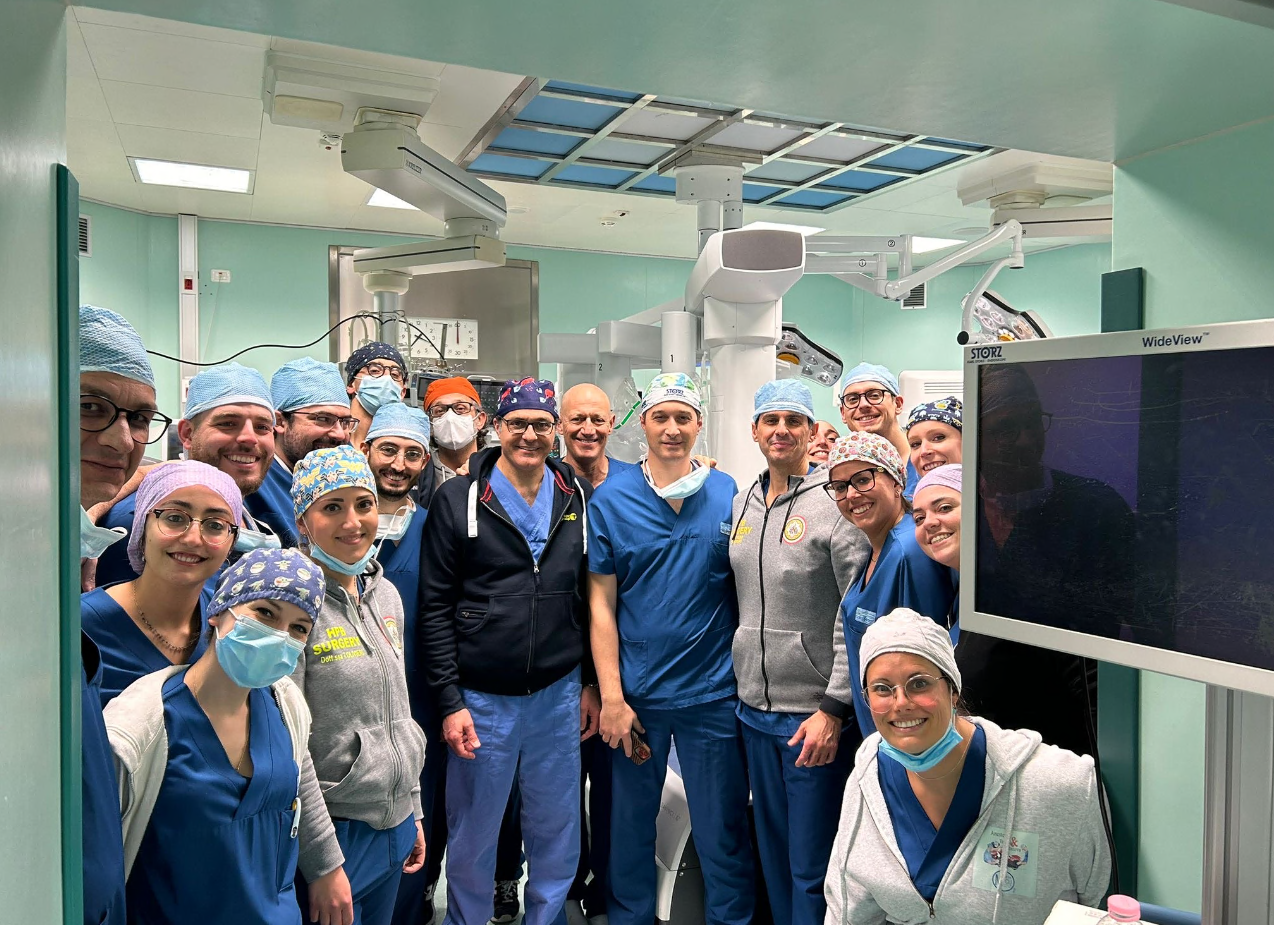
Di Benedetto was, in fact, the first surgeon in Europe and the second in the West to perform a completely robotic liver transplant from a living donor, and this milestone makes him a perfect and authoritative witness to explore what conditions should be created in our Island so that a young surgeon can aspire to world records without necessarily leaving Sicily.
Professor, for the robotic kidney retrieval and transplant procedure from a living donor between two priests, you also received a beautiful letter from Pope Francis. What did he write to you?
"Cardinal Pietro Parolin wrote to me on behalf of Pope Francis. He expressed 'personal and heartfelt gratitude from the Holy Father for what has been accomplished with great professionalism (...) with the sincere wish that each doctor, comforted and accompanied by the testimony offered, may strive to ensure that the care of health, the individual well-being of each patient, and the integral safeguarding of life are placed above any economic interest.'"
Professor, for the robotic kidney retrieval and transplant procedure from a living donor between two priests, you also received a beautiful letter from Pope Francis. What did he write to you?"I would say that today the choice must be increasingly informed and data-driven, not based on past perceptions. In Sicily, there are professionals and centers that have reached quality standards comparable to those in the North for many complex surgical procedures. The 'journey of hope' often arises from a lack of trust and communication. It is right for the patient to choose where they feel safest, but the goal is not to retain patients but to offer them the possibility of receiving care at home with the same quality standards. I am sure that Sicily can invest in facilities and technologies to guarantee its citizens a high standard of care."
Do you see a systematic collaboration in the near future between the centers of excellence in the North and those in Sicily for robotic procedures?
"Not only is it possible, but it is desirable. Modern medicine is a network, not territorial competition. Structured collaborations with joint training programs, fellowships, co-team interventions, teleproctoring, and sharing protocols can accelerate the growth of Sicilian centers and, at the same time, strengthen relationships with those in the North. Robotic surgery, by its digital nature, lends itself to this model: remote mentoring, shared audits, common databases. A national network of high complexity would be a qualitative leap for the entire healthcare system. These are very current topics that we also discussed during the first two consensus conferences on the role of robotic hepatobiliary surgery in Paris in December 2023, and on the role of organ transplants performed with fully robotic technology in Riyadh in 2024."
How will AI change transplant planning, and how close is Sicily to these global standards?
"Artificial intelligence will have a huge impact on three levels: more effective donor-recipient matching, with predictive models estimating the risk of rejection and long-term survival. Optimization of waiting lists, integrating clinical, social, and logistical parameters. Personalized surgical planning, with pre-operative simulations and advanced radiomic analyses. These are all topics on which the transplant center in Modena is active with dedicated research protocols, including ministerial funding for the implementation of robotic intraoperative navigation with augmented reality models that could allow for the future development of AI-assisted surgical systems. Sicily is already participating in national networks coordinated by the National Transplant Center, which operate according to international standards; therefore, adherence to global standards is already within reach of Sicilian centers."
What is the biggest obstacle to implementing robotics in the South: the cost of machinery or the lack of training centers?
"Cost is an important factor, but it is not the main one. The real critical issue is creating adequate activity volumes and structured training pathways. A surgical robot without a trained medical-nursing team and without a sufficient number of cases risks becoming underutilized. Certified training programs are needed, including the possibility of leveraging those already existing and certified at the European level, centralization of high complexities, investments not only in technology but in human capital. Technology can be purchased, but surgical culture is built over time."
What conditions should be created in Sicily so that a young surgeon can aspire to world records without leaving the Island?
"It is necessary to defend some key conditions, namely to guarantee real meritocracy in access to roles and career progression, support the development of advanced and sustainably funded technological infrastructures, enhance access to international clinical research, promote bidirectional mobility, meaning the ability to train abroad and return with a valued pathway, and finally, allow young people to rely on contractual and project stability that enables long-term planning. A young talent does not ask for privileges but for a competitive ecosystem. If this ecosystem consolidates, we will not only avoid brain drain but could attract professionals from other regions and abroad to Sicilian structures."
What does the daily life of a "top gun" in transplants look like?
"Our days are complex mosaics. There is no 'typical' day, but there is a constant discipline that holds together high specialization, clinical responsibility, and personal life. A transplant surgeon lives in a state of controlled alertness. The phone can ring at any moment: an available organ does not wait. This means interrupted holidays, nights in the operating room, sudden trips. Our training is a mix of cultural and technical. Precision is not only manual but also cognitive: anticipating complications, interpreting the peculiarities of each case, adapting in real-time are skills required at these levels of complexity. Coolness does not mean emotional detachment, but the ability to remain clear-headed when the unexpected happens. Family balance is certainly the most delicate part. Without a supportive and involved family, this job becomes unsustainable. It requires the ability to 'disconnect' when at home, even if it is not always easy."
Professor, is there a value or lesson learned in Sicily, perhaps from your early teachers or your family, that you carry with you into the operating room in Modena as a sort of ethical talisman?
"I grew up in Sicily, in a family environment oriented towards rigor and dedication to work; my father instilled in me a passion for surgery, which today represents a fundamental part of my educational journey. Emilia Romagna, a land of great ingenuity and work culture, has allowed me to put these family teachings into practice. I would like to quote a phrase from Enzo Ferrari: 'When you have an idea, you must believe in it wholeheartedly. No one will give you anything; no one will tell you that you are right. It will be your work and your determination that will prove it.'"